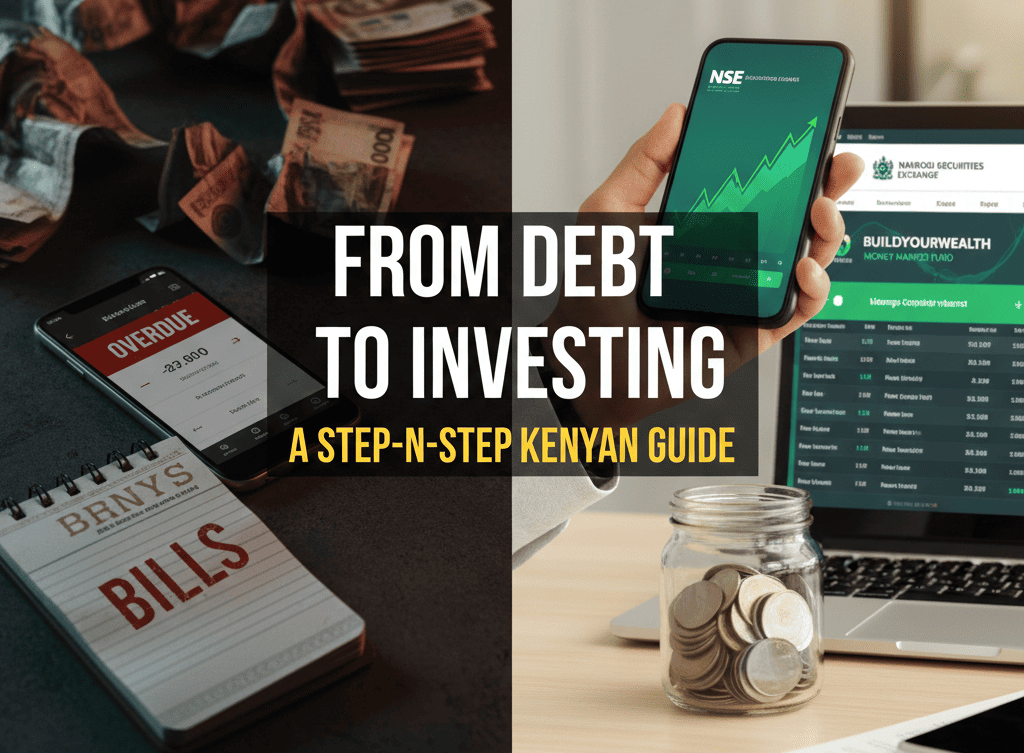
Expert financial consultant guide: Break free from digital loan cycles and start investing in MMFs and NSE stocks.
Right now, as you read this, thousands of Kenyans just like you are making a choice. Some are tapping "OK" on another Fuliza request. Others are opening their first Money Market Fund account.
The difference between these two groups isn't salary. It's not luck. It's a decision followed by a system.
At Buildyourwealth, we've guided hundreds of Kenyan professionals, entrepreneurs, and families through this exact transition—from owing money to owning assets. And here's what we've learned: the path from debt to investing is shorter than most people think.
Whether you're earning Ksh 30,000 or Ksh 300,000 a month, the principles remain the same. This isn't about perfection—it's about progress. Let's map out your journey, step by technical step, in language that actually makes sense.
Before we talk about building wealth, let's address the elephant in the room—those convenient loans sitting right in your M-Pesa menu.
M-Shwari charges a 7.5% facility fee plus 1.5% excise duty (total 9% upfront). That sounds reasonable until you realize it's for a 30-day loan. The effective annual rate? 90%.
Fuliza is even steeper: 1.083% daily maintenance fee translates to an annualized rate of 395.2%.
To put this in perspective: If you borrowed Ksh 10,000 on Fuliza and took the full 30 days to repay, you'd pay approximately Ksh 3,349 in fees. That's a third of your loan amount gone—money that could have been earning you 14-16% annually in a quality Money Market Fund.
Here's what we tell our clients at Buildyourwealth: If you're paying more than 15% interest on debt while keeping savings that earn less than that, you're running on a financial treadmill.
The uncomfortable truth? In early 2026, with the NSE All-Share Index up 49.88% year-over-year and certain counters delivering triple-digit returns, the real opportunity cost of staying in debt isn't just the interest you pay—it's the wealth you're not building.
You can't fix what you haven't measured. As financial consultants, we start every client relationship with a comprehensive debt audit. Here's your DIY version:
Open a simple spreadsheet or note app and list:
| Debt Source | Balance (Ksh) | Interest Rate | Monthly Payment | Maturity Date |
|---|---|---|---|---|
| M-Shwari | — | 90% APR | — | — |
| Fuliza | — | 395.2% APR | — | — |
| KCB M-Pesa | — | — | — | — |
| Sacco Loan | — | — | — | — |
| Bank Overdraft | — | — | — | — |
| Chama Loan | — | — | — | — |
Professional Principle: Any debt charging more than 15% annual interest should be eliminated before you invest a single shilling. Why? Because paying off a 90% loan is mathematically equivalent to earning a guaranteed 90% return on your money.
No Money Market Fund or stock will beat that.
Calculate your Debt Freedom Date: Based on how much you can allocate monthly to debt, when will you be completely free? Seeing this date makes it real.
Here's a pattern we see repeatedly: Someone starts investing, an emergency hits (medical bill, car repair, wedding contribution), they have no savings, so they either liquidate investments at a loss or—worse—take another loan.
The Emergency Fund breaks this cycle.
Starter Emergency Fund: Ksh 50,000 - Ksh 100,000
Full Emergency Fund: 3-6 months of essential expenses
Why not just a savings account? Let me show you the math:
Traditional Bank Savings: 3-5% annual interest
Top-Performing MMFs (January 2026):
Money Market Funds invest your money in:
This means:
Fund 1 - Ultra-Emergency (Ksh 20,000): Keep in highest-yield MMF for true emergencies
Fund 2 - Opportunity Fund (Rest): Slightly longer-term savings for planned expenses
Once your starter emergency fund is secure, it's time to aggressively eliminate high-interest debt. You have two proven strategies:
List debts by interest rate (highest first). Attack the most expensive debt while making minimum payments on others.
Example:
Avalanche Method: Pour all extra cash into clearing Fuliza first, then M-Shwari, then Chama, then Sacco.
Financial Win: Saves the most money in interest.
List debts by balance (smallest first). Attack the tiniest debt while making minimum payments on others.
Example (Same Debts):
Psychological Win: Quick victories create momentum and confidence.
Our Consulting Recommendation: If the interest rate difference is massive (Fuliza at 395% vs anything else), use Avalanche. If rates are somewhat similar, use Snowball for the motivation boost.
Most importantly? Pick one and commit. The worst strategy is the one you don't follow.
Congratulations! If you've reached this step, your high-interest debt is gone and you have an emergency cushion. You're now officially ready to build wealth.
Technical Reason: Money Market Funds provide:
Practical Reason: They teach you the discipline of not touching your investments while still offering quick access if needed.
Based on current performance data, here are the tiers:
Premium Tier (14-16% Returns):
Mid-Tier (10-14% Returns):
Entry-Friendly (Lower Minimums):
1. Net Yield Matters More Than Headline Rate
Look beyond the advertised rate. After management fees (typically 1.5-2.5%) and 15% withholding tax on interest, what do you actually take home?
Example: Dry Associates shows 16.25% headline but only 7.92% net. Madison shows 9.11% headline but delivers 10.29% net (yes, better!).
2. Accessibility Matches Your Goals
Building your first Ksh 100,000? Go for low-minimum funds like Britam.
Already have Ksh 500,000+ ready? Premium funds like GenAfrica (Ksh 500k minimum) make sense.
3. Withdrawal Speed
Scenario: You invest Ksh 10,000 monthly in a MMF averaging 12% annual return.
That's over Ksh 2.3 million from Ksh 120,000 in annual contributions. The extra Ksh 1.1 million? That's compound interest—your money making money.
With a solid MMF foundation (we typically recommend at least Ksh 200,000-500,000 here), you're ready for growth investing through the Nairobi Securities Exchange.
The NSE is experiencing remarkable momentum:
Translation: Kenyan stocks are thriving, making this an excellent time for disciplined, long-term investors to enter.
Step 1: Open a CDS (Central Depository System) Account
This is your "digital wallet" for shares. You can open one through:
Required Documents:
Cost: Typically Ksh 100-200 setup fee
Step 2: Fund Your Account
Link your bank account to your CDS account for seamless transfers.
Step 3: Place Your First Trade
Minimum Investment: You can buy as few as 100 shares (one board lot)
Example: Safaricom shares trading at Ksh 15.80 (approximate Jan 2026 price):
For your first Ksh 50,000-100,000 in stocks, focus on dividend-paying blue chips. These are established companies with track records of:
2026 Blue Chip Examples:
Banking Sector:
Telecommunications:
Consumer Goods:
Insurance:
Unlike Money Market Funds where your returns are automatic, stocks offer two ways to profit:
Example: You buy 1,000 Safaricom shares at Ksh 15.80 = Ksh 15,800 investment
If Safaricom pays a Ksh 1.50 dividend per share:
Never put all your stock money in one company. Start with at least 3-5 different stocks across different sectors.
Sample Beginner Portfolio (Ksh 100,000):
This diversification protects you if one sector underperforms.
| Phase | Monthly Income Allocation | Timeline | Goal |
|---|---|---|---|
| Phase 1: Stabilize | 20-30% to debt repayment | 3-12 months | Clear all debt over 15% interest |
| Phase 2: Secure | 20% to emergency fund | 6-12 months | Build Ksh 50-100k emergency cushion |
| Phase 3: Foundation | 15-25% to MMF | 12-24 months | Accumulate Ksh 200-500k in stable returns |
| Phase 4: Growth | 10-20% to NSE stocks | Ongoing | Build diversified stock portfolio for long-term wealth |
| Phase 5: Wealth | Reinvest dividends, rebalance | 5+ years | Financial independence through compounding |
Ziidi Trader: From January 2026, you can now buy and sell NSE shares directly via M-Pesa through this Safaricom-NSE collaboration. This means:
This innovation removes one of the biggest barriers for beginner investors—complicated account opening procedures.
The roadmap above will work if you follow it systematically. But here's what we've learned from working with hundreds of Kenyan investors:
At Buildyourwealth, we don't just tell you what to do—we walk with you through every step. From debt elimination strategies to portfolio construction to retirement planning, our financial consultants have helped Kenyans just like you build real, lasting wealth.
Ten years from now, you'll wish you had started today.
The Kenyan who starts investing Ksh 5,000 monthly at age 25 will have dramatically more wealth at 45 than the one who waits until 35 to start investing Ksh 20,000 monthly—even though the second person contributes more total money. That's the power of time and compounding.
Your financial transformation doesn't require a windfall, a promotion, or perfect conditions.
It requires a decision today, followed by consistent action tomorrow.
From all of us at Buildyourwealth: Your wealth journey starts now. Let's build it together.
Disclaimer: This article provides general financial education and should not be considered personalized investment advice. Market conditions change, and past performance doesn't guarantee future results. Please consult with a licensed financial consultant before making investment decisions. All data current as of January 2026.