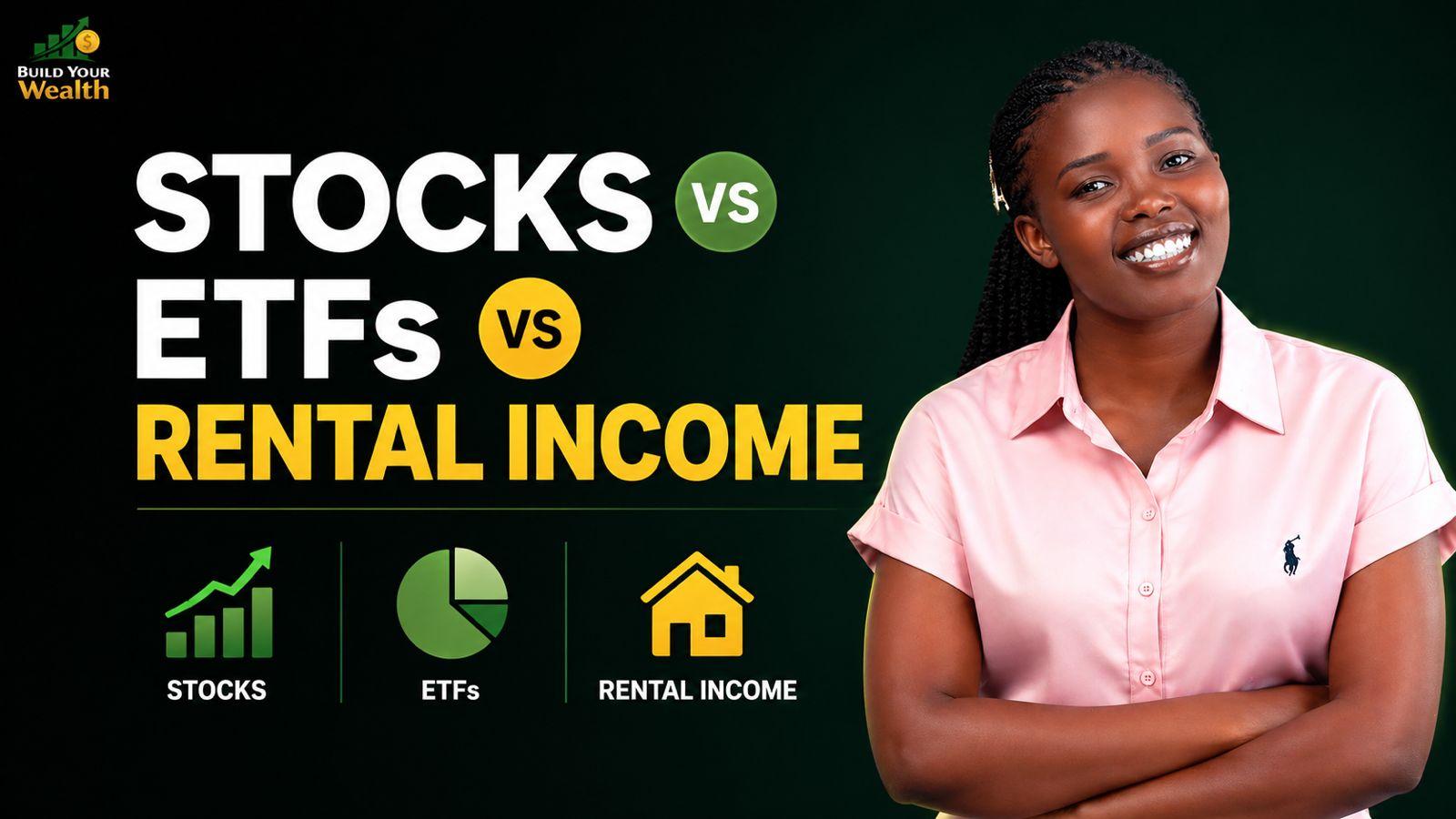
Beginner investors get conflicting advice. Some say buy stocks. Others say invest in property. Some swear by ETFs. Here's the truth: each has different pros, cons, and best uses. Let's break them down without the jargon.
If you're a beginner investor in Kenya, you've probably gotten conflicting advice. One person tells you, "Buy stocks - they have the best returns." Another says, "Forget stocks, invest in property for stable income." A third insists, "ETFs are the safest option for beginners."
So which one is actually worth your money? Which investment path should a beginner follow? Which offers the best returns? Which is safest?
The honest answer is: they're all right, but for different reasons and different people. Each investment type - stocks, ETFs, and rental income - has distinct characteristics, pros, and cons. The best choice depends on your situation: how much capital you have, your risk tolerance, how much time you can dedicate, and what your financial goals are.
This article breaks down all three investment types in plain, jargon-free language. By the end, you'll understand the real differences between stocks, ETFs, and rental income. You'll know the pros and cons of each. And you'll understand which one (or combination) is best for your specific situation.
Prefer to watch instead of read? We've got you:
Let's start with stocks, because this is probably the most confusing for beginners. Stocks are simple to understand once you get the basics.
A stock is a share of ownership in a company. When you buy a stock, you're buying a small piece of that company. Think of it like this: if a company has 10 shares total and you buy 1 share, you now own 1/10th of that company.
In Kenya, stocks are bought and sold through the Nairobi Securities Exchange (NSE) - a platform where traders buy and sell shares in Kenyan companies. Popular companies you can buy stocks in include Safaricom, KCB Bank, Equity Bank, and many others.
Stocks make you money in two ways:
Let's say you buy Safaricom stock for Ksh 10,000. The next month, it goes up to Ksh 11,000 (great!). But then the following month, due to market turmoil, inflation concerns, or company news, it drops to Ksh 8,500. You've lost Ksh 1,500. If you had to sell now due to an emergency, you'd take a loss.
This is why stocks are only suitable for money you won't need for at least 5-10 years. Short-term money and stocks don't mix well.
Key Insight: Stocks are the highest growth option but also the highest risk. The potential for big returns comes with the potential for significant losses. This is why most wealthy investors don't put all their money in stocks - they diversify.
Now let's talk about ETFs, Unit Trusts, and REITs. These are a completely different approach to investing - one that's much more suitable for beginners and busy investors.
ETF stands for Exchange-Traded Fund. Instead of picking one company's stock, you're investing in a basket of many companies at once. A professional fund manager does the work of selecting which companies to include in the fund.
Think of it like this: Instead of buying one type of fruit (bananas), you buy a basket containing many fruits (bananas, pineapples, avocados, grapes, mangoes). If one fruit has a bad year, the other fruits balance it out. This is called diversification - spreading your risk across many investments.
Unit Trusts are essentially the same concept as ETFs. They're funds managed by professionals that invest in multiple companies. The main difference is how they're traded and structured, but for beginners, they function almost identically.
REIT stands for Real Estate Investment Trust. REITs are a special type of fund that invests in real estate properties. This lets you be a "landlord" without actually owning or managing property yourself.
Instead of dealing with tenants, repairs, and maintenance, the fund handles everything. You just earn rental income payments. It's like owning property - without the headaches. Examples of REITs in Kenya include Amari and Acorn Holdings.
Let's compare two investors:
This is the power of diversification. One bad company doesn't destroy your portfolio.
Key Insight: ETFs and Unit Trusts offer the sweet spot between growth and stability. You get professional management, diversification, and reasonable returns without the stress and research requirements of individual stock picking.
Finally, let's talk about rental income - the traditional, most trusted wealth-building method in Kenya. Many Kenyans swear by rental property because it's tangible, visible, and directly under their control.
Rental income is money you earn by owning property (a house, apartment, or commercial space) and renting it to tenants. You collect monthly rent payments as passive income. This is the traditional path to wealth in Kenya, and many wealthy Kenyans have built significant fortunes this way.
You buy or build a property, rent it to tenants, and collect monthly payments. For example, you buy a house for Ksh 2,000,000 and rent it for Ksh 15,000 per month. Over time, that's Ksh 180,000 per year in rental income.
This is where many people get surprised. Rental income sounds passive, but it's actually quite hands-on:
You own a rental house generating Ksh 15,000 monthly (Ksh 180,000 yearly). That sounds great. But then:
Suddenly, your Ksh 180,000 in income becomes Ksh 35,000 in actual profit after costs. That's only a 1.75% return, not the 7.5% you thought!
Key Insight: Rental income is stable and offers property appreciation, but it requires significant capital, active management, and comes with hidden costs. It's not as "passive" as most people think. However, over very long periods (20-30 years), it can build tremendous wealth.
| Factor | Stocks | ETFs & Unit Trusts | Rental Income |
|---|---|---|---|
| Growth Potential | Highest (15-20%) | Moderate (8-15%) | Lowest (4-10%) |
| Risk Level | High | Low-Moderate | Moderate |
| Stability | Volatile | Stable | Stable |
| Capital Required | Low (Ksh 1,000+) | Low (Ksh 1,000+) | High (Ksh 1M+) |
| Management Required | High | None | Very High |
| Best For | Risk-tolerant, long-term investors | Beginners, busy professionals | Wealthy, patient investors |
| Liquidity | High (easy to sell) | High (easy to sell) | Low (slow to sell) |
Here's the truth that separates wealthy people from everyone else: they don't choose just one of these investment types. They use all three.
When you ask wealthy Kenyans where they invest, the answer is never "only stocks" or "only property." It's always a mix. This is called diversification, and it's the secret to building stable, powerful wealth.
When you use multiple investment types, you balance three important factors:
Here's what a balanced approach might look like for a Kenyan investor:
Year 1-2: Invest Ksh 5,000 monthly in a Unit Trust. Build your foundation and learn the ropes.
Year 3-5: Continue the Unit Trust investment. Start buying quality stocks (Ksh 2,000-5,000 monthly). You now have balanced growth.
Year 5+: Your investments have grown. Start looking at property investment. Build toward that Ksh 2M+ for a good rental property. Keep the stocks and ETFs growing.
By year 10, you have all three: stable ETF investments generating predictable returns, stocks for growth, and rental property for stable monthly income. This is how wealth is actually built.
The Diversification Principle: One bad investment type won't destroy you. If rental property performs poorly in a downturn, your stocks and ETFs are still working. If stocks crash, your rental income keeps coming. This is financial resilience.
Now comes the practical question: where should YOU start based on your situation?
Start with ETFs or Unit Trusts. You can invest as little as Ksh 1,000 monthly. This gives you diversification, professional management, and learning opportunity without requiring a fortune.
Combine ETFs with some individual stocks. Put 70% in ETFs (stability) and 30% in selected stocks (growth). This balances learning with protection.
Diversify across all three. Keep a solid foundation in ETFs, add quality stocks for growth, and start considering rental property when you're ready for the complexity.
Invest heavily in property while maintaining ETFs and stocks. Property is your wealth builder over decades, while liquid investments provide flexibility and additional income.
Universal Rule: Start small, stay consistent, and focus on learning before chasing profits. Wealth is not built overnight. It is built over time through consistent, smart investing combined with patience and discipline.
At Build Your Wealth, we help Kenyans create balanced investment portfolios that combine stocks, ETFs, and property investments. We help you determine which investment types are right for YOUR situation, capital, and goals.
The difference between someone who builds wealth and someone who doesn't isn't intelligence or hard work - it's strategy and diversification. Let's create yours.
Stocks offer the highest growth but highest risk. ETFs offer balance and beginner-friendliness. Rental income offers stability and appreciation. None is "best" - but together, they're powerful.
The conflicting advice you've heard is actually all correct. Stocks ARE great for long-term growth. Property IS a stable wealth builder. ETFs ARE perfect for beginners. The secret is understanding which is right for your situation and eventually combining them strategically.
Stop looking for the one "best" investment. Start looking for the balanced combination that matches your capital, goals, and personality. That's how real wealth is built in Kenya.
Start with what you have. Invest what you can. Learn as you go. Build diversification over time. Your future wealth depends on decisions you make today.
Disclaimer: This article is for general financial education purposes only and does not constitute personalised investment advice. All investments carry risk, including potential loss of principal. Past performance does not guarantee future results. Consult a licensed financial advisor before making specific investment decisions. All information is current as of May 2026.
Linda Jerono is a CPA Finalist and financial coach with a Master's degree in Accounting & Finance. She specializes in personal wealth management and financial education for Kenyans. With years of experience helping individuals, couples, and businesses navigate money management, Linda combines practical expertise with a passion for demystifying finance and empowering people to build sustainable wealth.
Build Your Wealth is a financial coaching platform founded by Linda Jerono to help everyday Kenyans master money management, invest wisely, and build lasting legacies. We offer personalized one-on-one coaching, practical financial guides, and educational resources covering budgeting, debt management, investing, retirement planning, and business finance—all tailored to the Kenyan context.
Stocks are individual company shares with high growth potential but high risk. ETFs are diversified funds holding multiple companies, offering balanced returns with lower risk. Rental income comes from owning property and earning monthly rent, offering stable returns but requiring significant capital and management.
Stocks typically offer the highest potential returns, but also carry the highest risk. Over long periods (10+ years), the average stock market return is around 15-20% annually. However, individual stocks can fluctuate significantly. ETFs offer more stable, moderate returns (8-15%), while rental income in Kenya typically returns 4-10% annually.